Chemical ID Card Layout Size Guide
Professional epoxy resin ID card design setup for CorelDRAW and Photoshop.
Learn correct card dimensions, 300 DPI settings, RGB workflow and industrial chemical ID card printing process.
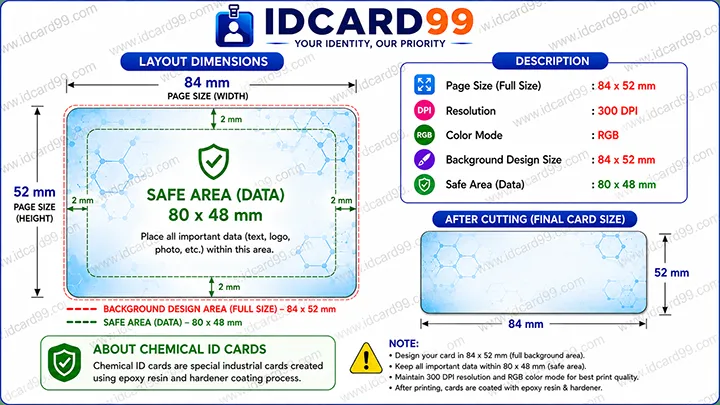
Chemical ID Card Size
- Open file size: 992 × 614 px
- Card size in MM: 84 × 52 MM
- Resolution: 300 DPI
- Color mode: RGB
- Design software: CorelDRAW & Photoshop
What is a Chemical ID Card?
Chemical ID cards are special industrial cards created using epoxy resin and hardener coating process. These cards are widely used where high durability, water resistance and long-lasting print quality are required.
Unlike standard PVC cards, chemical ID cards usually do not use rounded corners. The layout dimensions are slightly different because the production process and finishing style are different from regular PVC card printing.
These cards are commonly used in factories, industrial environments, chemical plants, heavy manufacturing companies and secure identification systems.
Chemical ID Card Design & Printing Process
Create New File
Open a new design file in CorelDRAW or Photoshop using 992 × 614 px size with 300 DPI RGB color settings.
Design the Card Layout
Create the complete ID card design including company logo, employee information, photo and branding elements.
Printing & Chemical Coating
After printing, epoxy resin and hardener coating is applied on the card surface to create a strong and durable finish.
12 Hour Chemical Process
The chemical coating process generally takes around 12 hours for proper drying and hardening before final use.
Benefits of Chemical ID Cards
Durable
Strong industrial quality finish for long-term use.
Water Resistant
Epoxy coating helps protect cards from moisture and damage.
Premium Finish
Smooth glossy surface gives a professional appearance.
Industrial Use
Suitable for factories, plants and secure workplaces.
Important Design Guidelines
- Always use 300 DPI resolution
- Keep logo and text properly aligned
- Use high-quality employee photos
- Export final design in high resolution
- Avoid low-quality compressed images
- Maintain correct card dimensions
- Use proper RGB color workflow
- Keep important text away from edges
Best Software for Chemical Card Design
Most professional designers create chemical ID card layouts using CorelDRAW and Photoshop. These applications provide better control over dimensions, color quality and print-ready export settings.
Photoshop is useful for photo editing and high-resolution image work, while CorelDRAW is commonly used for vector-based ID card layout design and industrial printing workflow.
Related Pages
Frequently Asked Questions
What is the size of a chemical ID card?
Chemical ID card size is generally created in 84 × 52 MM with 300 DPI RGB color setup.
Why are chemical cards different from PVC cards?
Chemical cards use epoxy resin and hardener coating process and usually do not use rounded corner finishing like standard PVC cards.
Which software is best for chemical card design?
CorelDRAW and Photoshop are commonly used for professional chemical card design creation.
How long does chemical coating process take?
The epoxy resin and hardener process usually takes around 12 hours for proper finishing and drying.
Need Professional Chemical ID Card Printing?
We provide professional chemical ID cards, PVC cards, RFID cards and custom printing solutions for factories, industries and businesses.
Contact Us