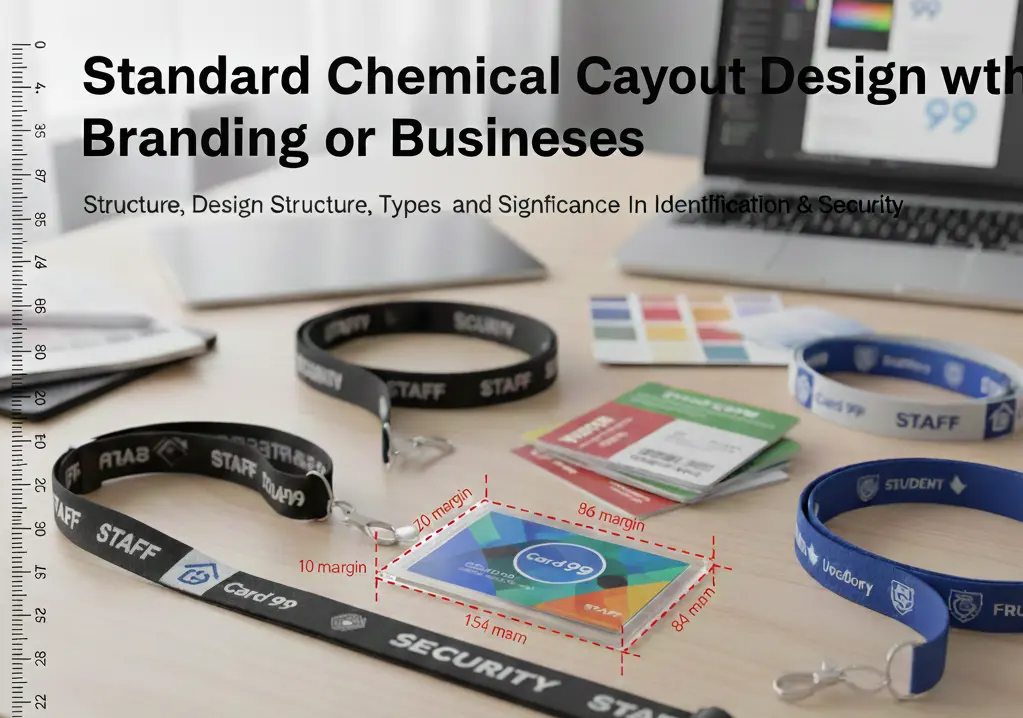
Chemical ID Card Layout Size: An Entire Guide to Industrial Identification.
Clear identification and structured information display are required in the industries which deal with chemicals, handle, store or process the chemicals. Chemical ID cards are crucial towards providing vital chemical related information in a readable and standard form in a little size. Nevertheless, the efficiency of a chemical ID card will be determined highly by its layout design and size requirements.
When selecting the correct chemical ID card layout and card size, to manufacturers, laboratories, educational institutions, and industrial facilities, it is important to be certain of the clarity, usability, and compatibility with printing and card-holding system.
This paper is an end-to-end practical guide on the layout of chemical ID cards and its design structure, card dimensions, layout, card orientation, card spacing, and card manufacturability.
What Is a Chemical ID Card?
A Chemical ID Card is a structured identification or information card that is created to conduct chemical related information in concise well organized way. The applications of these cards are:
- Chemical laboratories
- Industrial plants
- Manufacturing units
- Educational institutions
- Storage spaces and warehouses.
- Safety documentation systems.
A chemical ID card is a convenient tool as opposed to a detailed safety manual or data sheet. It is efficient in terms of how effectively the information is presented in a small size that fits on a card.
Significance of Chemical ID Card Layout.
The composition of a chemical ID card is the manner in which information is grouped, aligned and graphically organized on the card. This is necessary because a good layout will make sure that the card is:
- Easy to read at a glance
- Visually balanced
- Professionally presented
- Indicating, at least, that it can be printed and laminated.
- Card holder and accessories are compatible.
The wrong structure can lead to sickness, crowding or confusion whereas the right structure enhances ease of use as well as making the layout more presentable.
Normal Dimensions of Chemical ID Cards.
CR80 – The Industry Standard
Majority of the chemical ID cards have size of CR80 which is the same size as a credit card.
Standard Dimensions:
- Width: 85.6 mm
- Height: 54 mm
- Thickness: 0.76mm (thickness of standard PVC card)
This dimension is universally accepted and compatible with:
- ID card printers
- Card holder
- Lanyards
- Wallet inserts
- Badge reels
The standard size will make sure that the chemical card is easy to print, store, and carry.
The Chemical Card Layout Orientation Options.
1. Landscape Orientation
- Width is longer than height
- Suitable to a horizontal layout.
- Allows wider text fields
- Placed on shelf cards and in container labels that are commonly used.
2. Portrait Orientation
- Height is longer than width
- Vertical holders should be suitable.
- Well groomed and orderly look.
- Usually found in institutional and educational arrangement.
The decision on orientation is based on:
- Amount of information
- Holder type
- Visual preference
- Industry practice
Important Areas of a Chemical ID Card Design.
A chemical identification card plan is broken down into well-coordinated parts. These sections ought to be placed in a logical reading sequence which normally takes the form of top down or left to right.
1. Header Section
This is the upper part of the card and it normally consists of:
- Chemical name
- Product or reference name
- Company / institution logo (not compulsory)
The header should use:
- Bold typography
- Larger font size
- High visibility visibility contrast.
2. Information Block Area
The section presents organized chemical related information like:
- Chemical formula
- Category or classification
- Reference code or ID
Layout tips:
- Use aligned columns or boxes
- Avoid long paragraphs
- Keep a regular spacing.
3. Symbol & Icon Area
There tends to be common symbols or icons on chemical cards. The layout should:
- Note down a special place of symbols.
- Maintain equal icon size
- Avoid clutter
The icons are to be located in the places where they can be expected at a glance without overwhelming the text.
4. Notes or Instructional Section.
In this area are contained short instructions or comments. From a layout perspective:
- Keep text concise
- Where applicable use bullet points.
- Avoid very small fonts
In this part, the card should not be dominated but it should be readable.
5. Footer Section
The lower section of the card is normally composed of:
- Name of manufacturer or supplier.
- Issue or revision date
- Reference number/ batch code.
Smaller fonts should be used in the footer but in a clear way.
Guidelines Font Selection & Typography.
Typography is very important in the readability of the cards.
Characteristics of Fonts Recommended:
- Sans-serf typeface(clean and modern)
- Medium to bold fonts on the headings.
- Regular weight for body text
Font Size Guidelines:
- Header: 10–12 pt
- Body text: 6–8 pt
- Footer text: 5–6 pt
Simple fonts should also be used since in chemical cards clarity is more essential rather than the style.
Spacing, Margins & Bleed Area
Margins
- Minimum safe margin: 2–3 mm
- Stops text cut page printing.
Bleed Area
- Bleed: 3 mm on all sides
- Guarantees clean edges finishing of trimming.
Correct margin and bleed are necessary in manufacturing of quality.
Chemical Card Layout Color Usage.
The use of color is supportive in layout design.
Best Practices:
- Strong contrasting between the text and the background.
- Limited color palette
- Same color use in cards.
Stereotypical color conventions of layout:
- The background should be light so that it is easy to read.
- Dark text for clarity
- Colors of accent used to separate sections.
Too much color should be avoided as it will lower the visual perception of small cards.
Front & Back Layout Design
Front Side
- Primary identification information.
- Chemical name and symbols
- Most commonly mentioned data.
Back Side
- Secondary information
- Instructions or notes
- Additional references
This facilitates more efficient distribution of information through both sides which will not be overcrowded.
Print Compatibility and Print Manufacturing.
As a manufacturing concern, chemical ID card layouts need to be:
- Status Reads with PVC cards.
- Suitable for lamination
- Resistant to smudging
- Obvious following subtraction and rounding.
Layouts should avoid:
- Very thin lines
- Extremely small text
- Overlapping elements
Chemical Card Layouts Customization Alternatives.
The layouts can be customized by a professional manufacturer according to:
- Client branding
- Logo placement
- Color themes
- Orientation preference
- Information priority
Even though customization is necessary, standard size and layout balance must never be compromised.
Online vs Paper Chemical Card Designs.
Printed Chemical Cards
- Physical PVC cards
- Fixed layout
- Used on-site
- Requires durable design
Digital Chemical Cards
- Displayed on screens
- Same layout that is transformed into a digital one.
- Often include QR codes
More modern layouts are typically created to operate in either format.
Some of the mistakes to avoid in layouts.
- Overcrowding information
- Using very small fonts
- Poor contrast
- Inconsistent alignment
- Disregard of conventional size
A neat, plain and well organised design is ever more efficient.
The importance of Standardized Layouts.
A uniform card design in chemical is beneficial as it provides;
- Faster recognition
- Consistent understanding
- Reduced errors
- Easier training
- Professional appearance
This is particularly so in the case of organizations dealing with various chemicals and hence standardization.
Conclusion
The success of a chemical ID card only depends on the layout and size design. Chemical ID cards are made understandable, dependable, and usable by adhering to normal card sizes, systematic arrangement of layout, and professional designing.
To the manufacturers, paying attention to layouts, compatibility on printing and the standard of size would guarantee quality work and satisfaction among the customers. A well-constructed chemical ID card layout will be helpful in the industrial facilities, laboratories, and educational institutions in terms of the clarity, consistency, and professional identification.
Chemical Card Layout FAQs
Answers to common questions about chemical card layout — how they work, sizes and more.
Need Custom Lanyard & Id Cards?
Get high-quality PVC, RFID, digital membership, etc. cards tailored to your business.
Request a Free Quote