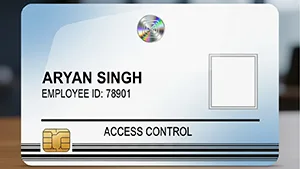
What is Access Control Card?
Access control card is more or less a digital key. Users carry a security card, which is associated with a certain security system instead of them carrying around a traditional key that can easily get lost or reproduced. The card can communicate with the system once swiped, tapped, or read at a reader to know whether the individual is permitted to go into the premises. Every card carries a distinct data either in the form of ID Number or encrypted data which the control system has to match before opening an access.
These cards are programmable, erased, and upgraded under non-replaced physical hardware as compared to common keys. This renders them flexible and affordable particularly in the large organizations.
Types of Access Control Cards
-
Magnetic Stripe Cards
Magnetic strip cards are quite similar to credit cards. On the back, they contain black or brown stripe that stores data. They are inexpensive but widely applicable thus they can become worn out with time and are easily copied. -
Proximity Cards
Commonly known as prox cards, proximity cards are based on radio-frequency identification (RFID). All they have to do is wave or tap the card on the reader to get in-swiping required. They are error-prone and ensure proper security as compared to magnet stripe cards. -
Smart Cards
Smart cards are embedded with data processing and storing microchips. They are more secure since they have the capacity to contain encrypted information thus, they are difficult to hack. They are accessible and multipurpose too, they can be utilized as an access control mechanism and other things such as payment systems. -
Biometric-Enabled Cards
These cards have a traditional card technology merged with biometric verification-finger prints or facial recognition-to provide additional security. They can be found in places with a heavy security level (such as in a research lab or government complex).
The Way Access Control Cards Work
The access control cards have a simple but very effective working principle. As a user swipes the card before a reader, the machine reads whatever information has been programmed into it- on a magnetic strip, RFID chip, or microchip. This information is passed to a central control system where it is compared with an authorized users database. When there is compatibility between the credentials access is granted otherwise the door is closed.
In the more sophisticated systems this is done in milliseconds. Time tracking is also incorporated into many organizations and enables them to track the attendance patterns and entrances.
Advantages of Access Control Cards
It is not all about barricading unauthorized individuals, access control cards come with a range of advantages:
- Ease of use: You do not have to fumble with keys, instead; a mere tap or swipe is enough.
- Economical Security- When an identified card is lost it can be disabled immediately without being forced to change locks.
- Scalability - Adding new employees or residents is fast.
- Tight Access Logs - Systems are able to log who entered where and when.
- Editable Rights – Rights can be configured such that only specified areas or times of access will be allowed.
To businesses, these benefits come in the form of enhanced efficiencies and increased level of security. To the residents, they translate to peace of mind.
Use in Other Sectors
- Corporate Offices- To ensure offices and ensure offices are restricted to employees.
- Educational Institutions - Classrooms access and student use ID.
- Healthcare Facilities- To guard such vulnerable places as pharmacies or patient records rooms.
- Residential Complexes ? Main entrance gates, gyms and parking.
- Government Buildings- Room storage of classified documents and high-security area.
These cards are flexible and suitable in any type of environment that attaches importance to safety as well as efficiency.
The Modern Access Cards Security Features
Current access control cards have more high security functions such as encryption, rolling codes and dual authentication. A lot of them also employ the use of two-factor authentication (2FA) which entails both a card and a PIN or biometric verification. Even some of the cards utilize desfire technology which makes the access code constantly change to avoid cloning.
Such innovations improve the situation to the extent that in case of any card theft, it is almost impossible to use it without authorization.
Some of the most widely practiced errors in access card management
Sometimes even a highly developed security could be spoiled by bad management. Typical mistakes consist of:
- The inability to Deactivate Lost Cards Leaving Gaps in Security.
- Exchanging Cards among Users -Breach of traceability.
- Abandoning Security Updates-Losing new security patches.
- Weak Authentication Settings - Grants of excessive access privileges.
Periodic audits and training are some of the remedies of these pitfalls in an organization.
Trends in future Access Control Technology
These access control cards have their future in the domain of mobile integration and cloud-based systems. Any time soon, numerous cards can be replaced (or complemented) by smartphone-based-credentials. The use of biometric authentication will become rampant and use of AI-powered analytics will improve threat detection. There is also a likelihood of witnessing increased utilization of multi-technology cards that can be used across various systems and facilities.
Conclusion
Access control cards are not a mere tool to get inside; it is an engulfment of security, convenience, and adaptability at the same time. They will remain so as long as we continue to advance in technology in terms of the protection of buildings, data, and persons.
Access Control Card FAQs
Answers to common questions about access control cards — how they work, security, policies and more.
Need Custom Access Control Cards?
Get high-quality PVC, RFID, digital membership, etc. cards tailored to your business.
Request a Free Quote